Limbo
Limbo, the First Circle of Hell, is the eternal abode of the virtuous unbaptized—those who lived before Christianity or died without baptism—and constitutes the least painful region of the Inferno, yet one defined by a unique and permanent sorrow: the absence of hope. It is a place not of physical torment but of unfulfilled desire, where the inhabitants, including the poet Virgil himself, dwell in a state of perpetual longing for a divine vision they are forever denied. This circle represents the borderland between the damned and the merely excluded, a realm of profound philosophical and theological significance within Dante's moral cosmos.
Location and Physical Description
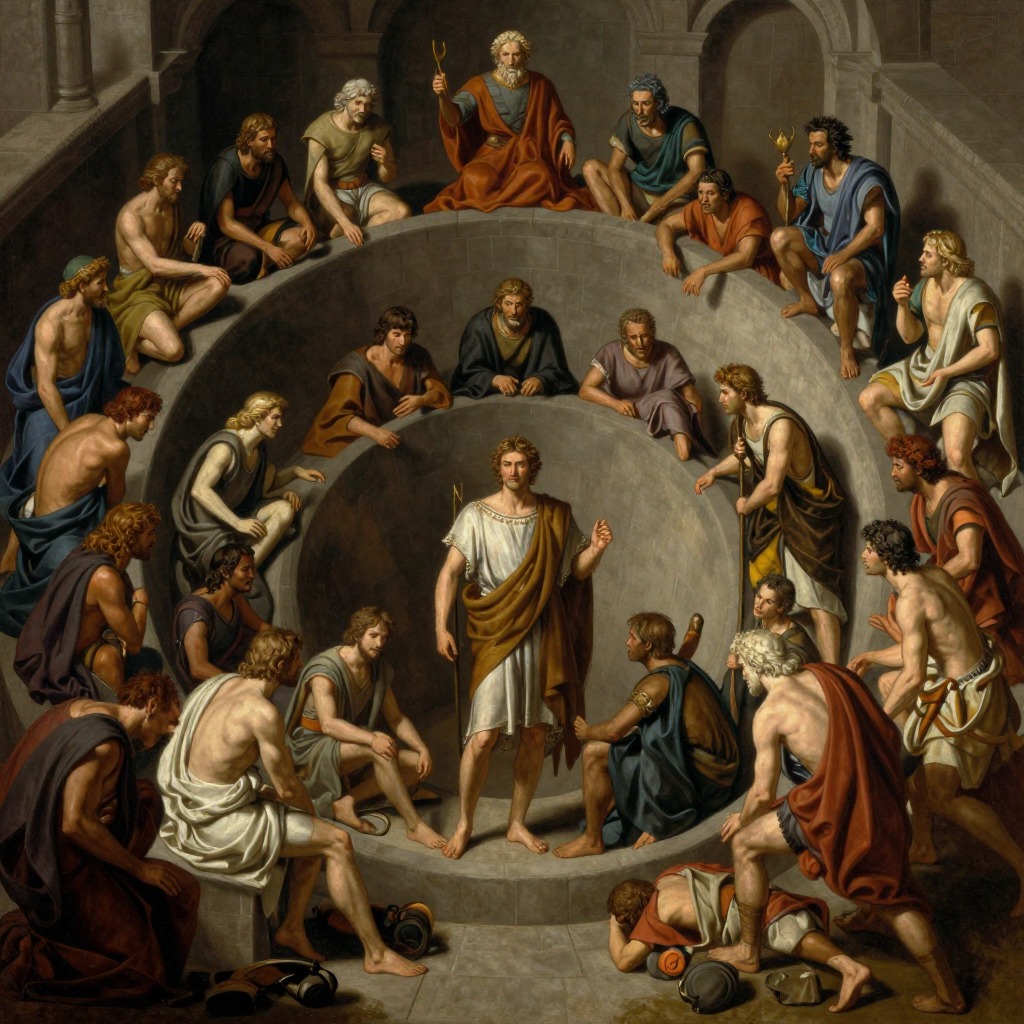
Limbo is the first of the nine concentric circles of Hell, situated immediately inside the Gate of Hell and just beyond the river Acheron. It is described as an "abysmal valley dolorous" that is "obscure, profound, and nebulous," yet it is distinct from the circles below in that it contains no active tortures. The air is filled not with shrieks or wailing but with sighs that "tremble made the everlasting air," a sound that arises from "sorrow without torment." The landscape is a "forest of thick-crowded ghosts," a vast, shadowy expanse where the souls of the unbaptized and the virtuous pagans reside. Within this forest, a notable feature is a "noble castle" surrounded by seven walls and a fair rivulet, which houses the greatest spirits of the classical world. This castle, a place of honor and light within the darkness, is reached by passing through seven portals and entering a "meadow of fresh verdure" where the inhabitants speak "but seldom, and with gentle voices."
Inhabitants and Their Condition
The souls in Limbo are those who "sinned not" but lacked baptism, "which is the portal of the Faith thou holdest," or who lived before Christianity and "in the right manner they adored not God." Virgil himself explains that he is among them, stating, "for such defects, and not for other guilt, lost are we and are only so far punished, that without hope we live on in desire." This is the defining paradox of Limbo: the souls are not actively tormented, yet their punishment is a profound and eternal deprivation. They possess full intellectual and moral virtue but are forever cut off from the beatific vision of God. The inhabitants include a vast multitude of "infants and of women and of men," all suspended in this state of endless yearning. The only exception to this rule was the Harrowing of Hell, when Christ, a "Mighty One with sign of victory incoronate," descended and drew forth the souls of the Old Testament patriarchs—Adam, Abel, Noah, Moses, Abraham, David, and others—releasing them from Limbo and bringing them to salvation.
The Noble Castle and the Honorable People
Within the forest of Limbo, a special area is reserved for the most illustrious figures of the ancient world, who are distinguished by the honor they receive. A fire "overcame a hemisphere of darkness," and within its glow, Dante sees "that honourable people" who are set apart by their fame. Virgil explains that "the honourable name, that sounds of them above there in thy life, wins grace in Heaven, so that advances them." This group is led by the four great poets of antiquity: Homer, Horace, Ovid, and Lucan, who welcome Virgil as one of their own and, in a gesture of supreme honor, make Dante "the sixth was I, 'mid so much wit." They proceed to the Noble Castle, where the greatest heroes and thinkers of the classical world are gathered. Dante sees figures from myth and history: Electra, Hector, Aeneas, Caesar, Camilla, Penthesilea, King Latinus, Lavinia, Brutus who drove out Tarquin, Lucretia, Julia, Marcia, Cornelia, and the Saladin. In a separate, more elevated group, he beholds the philosophers: Socrates, Plato, Democritus, Diogenes, Anaxagoras, Thales, Zeno, Empedocles, Heraclitus, Dioscorides, Orpheus, Tully, Livy, Seneca, Euclid, Ptolemy, Galen, Hippocrates, Avicenna, and Averroes. This assembly represents the pinnacle of human achievement in the absence of divine revelation, a testament to the value of virtue and wisdom even when they are not informed by Christian faith.
Thematic Significance
Limbo serves as a crucial theological and philosophical statement within the Divine Comedy. It embodies the doctrine that baptism is necessary for salvation, yet it also acknowledges the inherent worth of pagan virtue and classical learning. The souls in Limbo are not punished for their sins but are excluded from Heaven due to a circumstance—their birth before Christ or lack of baptism—that is not their fault. This creates a tension between divine justice and human sympathy, a tension that Dante himself feels when he experiences "great grief" upon learning that many "people of much worthiness" are confined there. The circle also functions as a narrative and structural threshold: it is the first place where Dante encounters the damned (or, more precisely, the excluded), and it establishes the principle of contrapasso—the idea that the punishment fits the sin—in its most subtle form. The punishment of Limbo is the absence of God, a state of eternal desire without fulfillment, which is the most fitting consequence for those who, through no fault of their own, never knew the object of their longing. In the broader cosmology of the poem, Limbo represents the limit of human reason unaided by grace, a realm where the greatest minds of antiquity are forever stalled, unable to ascend to the beatific vision that is the ultimate goal of the entire journey.